Skip to content

Common Stored Product Pests in Commercial Facilities

Serving Ocala | St Augustine | Gainesville | Palm Valley

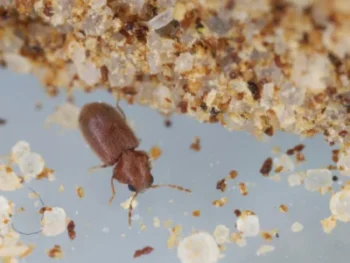
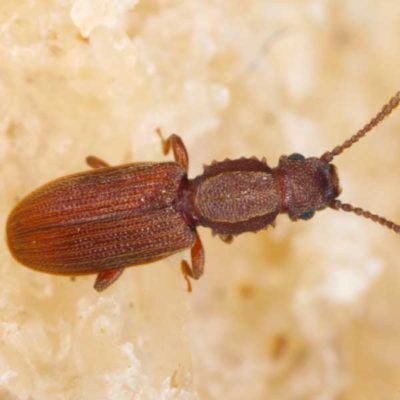
Macro photograph of a reddish-brown stored product pest crawling next to a clump of processed grain particles and salt crystals.If your Jacksonville FL business handles grain, dry goods, or packaged food products, you already know how much effort goes into protecting your inventory. But no matter how careful your storage and handling practices are, product pests can still slip through.

These small but destructive insects will wreak havoc on your operations, contaminate products, damage packaging, and put equipment at risk. Left unchecked, an infestation can cause failed health inspections, disrupted operations, and permanent damage to your business’s reputation.

Bug Out has seen firsthand how fast these infestations spiral out of control, and how much of a difference early detection makes. Since each pest species behaves differently, correctly identifying what you’re dealing with is the first step toward effective treatment.

Stored Product Pests to Watch Out For

Facilities that handle dry goods deal with many risks of stored product pests, each with their own habits and warning signs. Knowing what to look for makes all the difference in catching an infestation early:

Indian Meal Moth up close white background

Indian Meal Moth

As one of the most widespread stored product pests in the food industry, Indian meal moths show up frequently in dry goods facilities. They’re especially problematic because of how many different products they’ll infest. Grains, cereals, nuts, and pet food are all at risk.

Their larvae are a major issue, spinning webbing as they feed. This webbing forms sticky clumps throughout infested products and is often the first clue that something’s wrong. Adult moths are fairly easy to spot thanks to their distinctive two-toned wings, with bronze or copper coloring on the outer half, and grayish-white on the inner half.

Warehouse Beetle

Warehouse beetles pose a serious threat to businesses storing dry goods, since they can establish themselves in overlooked corners and spread with surprising speed. These adaptable pests thrive even where only trace amounts of food debris are present.

What makes them especially tough to manage is their ability to survive on almost nothing. Their bodies are covered in tiny hairs that can contaminate stored products and, in some cases, trigger allergic reactions. Look for oval-shaped insects ranging from dark brown to black, often marked with lighter patterns on their wings.

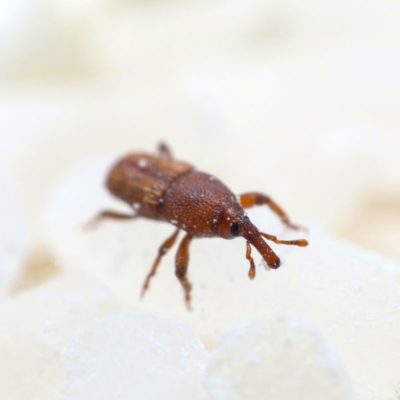
Rice Weevil up close on counter

Rice Weevil

Rice weevils are commonly found in stored rice, but they’ll just as readily infest wheat, corn, barley, and other cereal grains. They typically enter facilities inside infested shipments, making them a recurring headache in storage and distribution settings.

Because rice weevils can fly, they spread quickly once established. Adults are small, reddish-brown beetles with a noticeably elongated snout, which makes them somewhat easier to identify than other stored product pests.

Drugstore Beetle

The drugstore beetle has earned its reputation by infesting a wide range of materials, including food products, spices, and even medications. Their broad appetite makes them a persistent nuisance in both commercial and storage settings.

You might find these beetles in less obvious places, including dried plants, decorative items, and packaged goods. They’re reddish-brown with a rounded, hump-backed shape that sets them apart from similar-looking pests.

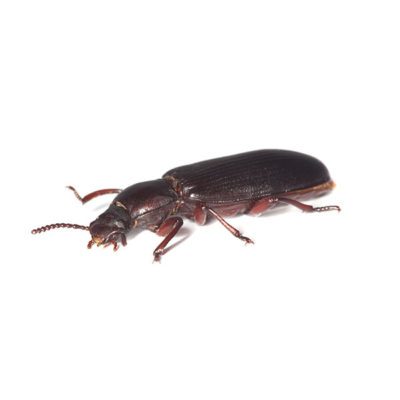
Confused Flour Beetle up close white background

Flour Beetle

Unlike pests that target whole grains, flour beetles gravitate toward processed food products such as flour, cake mixes, cereals, and other milled goods.

Two nearly identical types exist: the red flour beetle and the confused flour beetle. Both are small, flat, and reddish-brown, differing mainly in antennae shape and flight capability. Only the red flour beetle is able to fly.

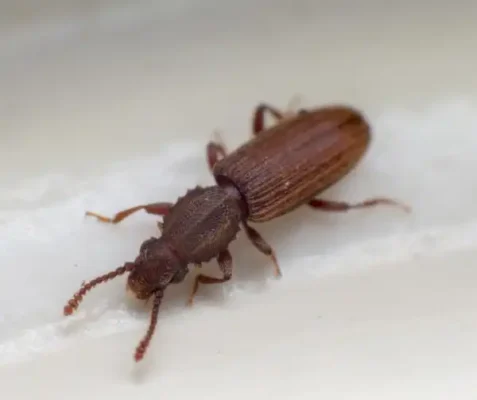
Merchant Grain Beetle up close white background.

Merchant Grain Beetle

Merchant grain beetles prefer oily food products like nuts, seeds, cereals, dried fruits, and chocolate. They’re particularly difficult to control because of how easily they access tightly sealed packaging.

Their flat, slender bodies let them squeeze through remarkably small openings, which makes standard packaging far less effective as a barrier. These small brown beetles are identifiable by the saw-like projections running along the sides of their thorax.

Cigarette Beetle

Best known for infesting tobacco products, cigarette beetles also target spices, dried herbs, cereals, pet food, and even certain paper-based materials.

Measuring about an eighth of an inch long, these beetles have a rounded, hump-backed shape similar to the drugstore beetle. The main difference is the antennae. Cigarette beetles have saw-like antennae, while drugstore beetles have club-shaped ones.

Sawtoothed Grain Beetle up close on counter

Sawtoothed Grain Beetle

Named for the saw-like ridges along the sides of its thorax, the sawtoothed grain beetle is a close relative of the merchant grain beetle and shares many of the same habits and preferred environments.

These pests can be found in flour, cereal, pasta, dried fruits, and sugar. Their flat bodies let them slip into packaging that looks perfectly sealed, making them a persistent problem in storage facilities.

Signs You May Have a Stored Product Pest Problem

The longer stored product pests go unnoticed, the more damage they’ll cause to your inventory and operations. Catching the warning signs early is the best way to prevent a minor issue from turning into an infestation:

  • Damaged Packaging: Torn, chewed, or otherwise compromised packaging often means pests have reached the contents inside.
  • Webbing: Webbing, particularly from moth larvae, is a clear sign of active feeding within stored products.
  • Frass: These small droppings indicate pests are actively feeding and present in the area.
  • Unusual Odors: Musty or strange smells can develop as pest activity contaminates goods.
  • Larvae or Grubs: Spotting larvae or grubs in or around products indicates an infestation has already begun.
  • Adult Insects: Seeing live insects around stored products or throughout your facility is a strong sign of active infestation.

How to Manage Stored Product Pests in Your Facility

Staying vigilant is one of the most effective ways to keep stored product pests under control. These insects are notorious for spreading, especially once contaminated goods get into a facility. Routine inspections, ongoing monitoring, and professional support all prevent infestations before they escalate.

Store-bought treatments and DIY methods generally aren’t enough for infestations on a commercial scale. Pest control professionals use fumigation, conventional sprays, and ultra-low volume applications to target pests at every stage of development. Fumigation is an important option, because it can penetrate deep into stored products and reach pests hiding in places that are otherwise inaccessible.

Any sign of a potential pest problem needs immediate action. The longer an infestation is allowed to continue, the more damage it will cause and the harder it becomes to control. Partnering with stored product pest control professionals is the most reliable way to tackle these issues, and Bug Out regularly helps businesses manage these situations.

Protect Your company by Choosing Bug Outย 

Businesses in Jacksonville FL often struggle with stored product pests because these insects are so good at staying hidden. Their ability to infiltrate packaged goods and spread without detection makes them difficult to manage without the right tools and expertise, which means problems can become serious before anyone notices.

Bug Out works hand-in-hand with our clients to build a clear, effective treatment plan. Our process follows a structured approach of identification, prevention, monitoring, and suppression, all grounded in an Integrated Pest Management (IPM) framework. Our goal is to provide you with consistent, reliable results that protect both your operations and your inventory.

Contact Bug Out today to schedule your free assessment and see what sets our team apart.

Back to Pantry Pest Control

Skip the form! Call for your FREE inspection

*During normal business hours. After hours calls will be returned the next business day.